Lift Elevator PCB Repair
Lift control electronics and printed circuit boards are critical components in modern elevator systems. These boards manage signal processing, safety circuits, input/output control and communication with encoders and sensors throughout the lift system. When faults occur within these boards, careful diagnostics and component-level repairs can often restore reliable operation without requiring complete replacement.
One repair involved a lift PCB from an Orona system, Board 5124381. The board was submitted for inspection with no obvious signs of physical damage. Initial testing confirmed that the majority of the diode components were functioning correctly, however further testing around the relay circuits identified three additional diodes associated with relays 4, 5 and 6. One of these diodes had failed and was replaced. The board’s internal power supplies were then tested by applying an 18V DC supply to capacitor C22. The 12V and 5V rails were confirmed to be operating correctly. A 240V input test was also conducted to verify the 24V supply, which showed minimal ripple and stable operation. Further signal tracing suggested that the reported issue may have originated from the external encoder system rather than the board itself. We have also worked on board number 5124423 and 5124438.
Another repair involved a Helios 3 lift control circuit board, EMC Main Board VPL121. The reported issue was that one of the board inputs was not functioning correctly. Initial inspection did not reveal any obvious damage to diodes or resistors. The board was powered using a 24V supply and a switch box was connected to simulate input signals. Testing confirmed the input fault described by the client. While probing the circuit, it was observed that the LED indicator responded when pressure was applied to a resistor using the multimeter probe. Further investigation showed that the resistor had a failed connection and detached during desoldering. The resistor was replaced with a new 1K 0.75W component and surrounding resistors were reworked to ensure proper solder joints. The board was then prepared for onsite testing.
A further lift electronics repair involved a Schindler lift panel assembly. Inspection identified corrosion damage affecting a ribbon cable connection. Initial attempts to repair the damaged ribbon tracks by soldering were unsuccessful, so a conductive repair approach was attempted using silver conductive material to redraw the damaged tracks. When this method did not provide a reliable connection, an alternative repair was performed by soldering individual wires directly to the PCB and bonding them to the ribbon cable using conductive material and adhesive for mechanical stability. In addition to the ribbon cable repair, relay components on a related lift PCB assembly were also replaced as part of the service work.
These examples highlight the range of PCB-level repairs that can be carried out on lift control electronics. Through careful diagnostics, component replacement, and circuit repair techniques, many faults can be resolved without requiring full board replacement, helping to reduce equipment downtime and maintain the reliability of lift control systems.
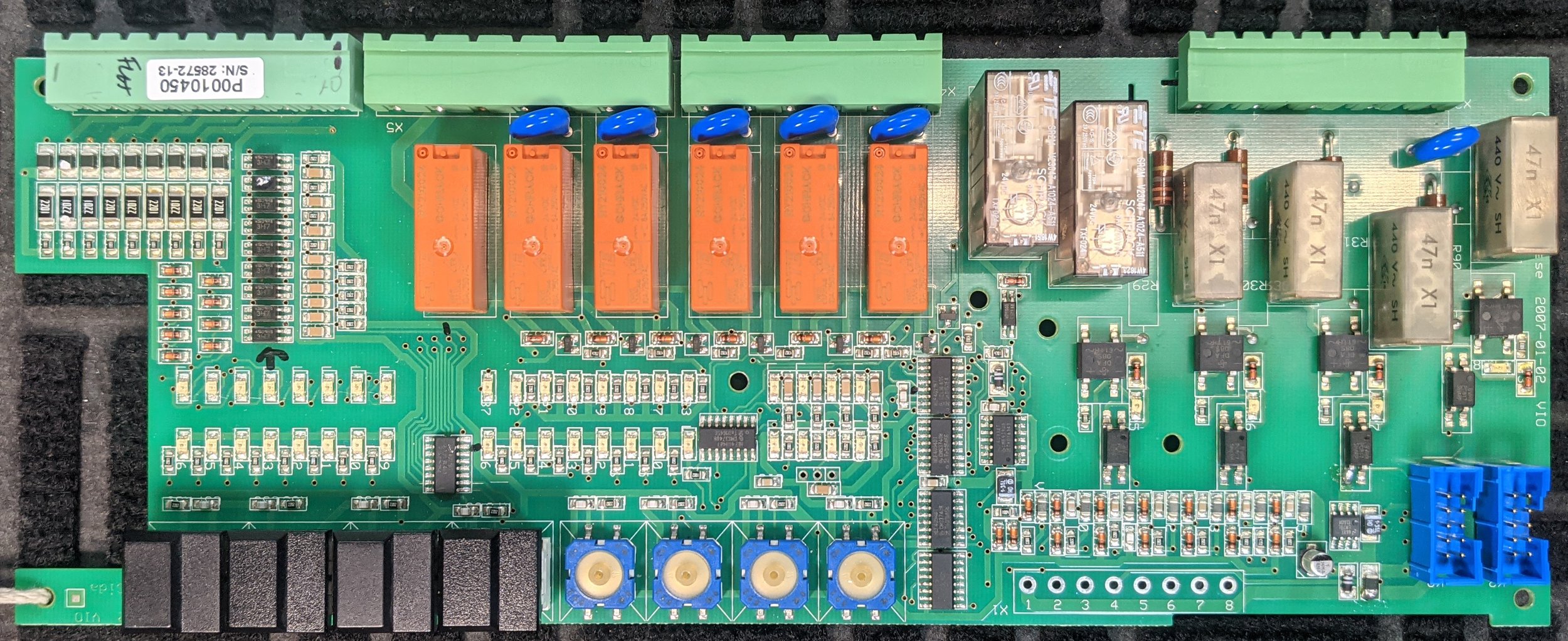
Control PCB from a Lift