
Perforator Control System for a Printing Line
Project by Michael Smart.
A printing customer needed their perforator table to lift and lower the perforating wheels on the moving web at precise positions — and to do it reliably at production speed.
We designed the sensing and control approach, built the cabinet in our workshop, installed it on site, and commissioned the system through to proven running at 100 metres per minute.
The requirement
The perforator had to drive the wheels up and down on the product at specific times, for specific distances, while the paper roll was running.
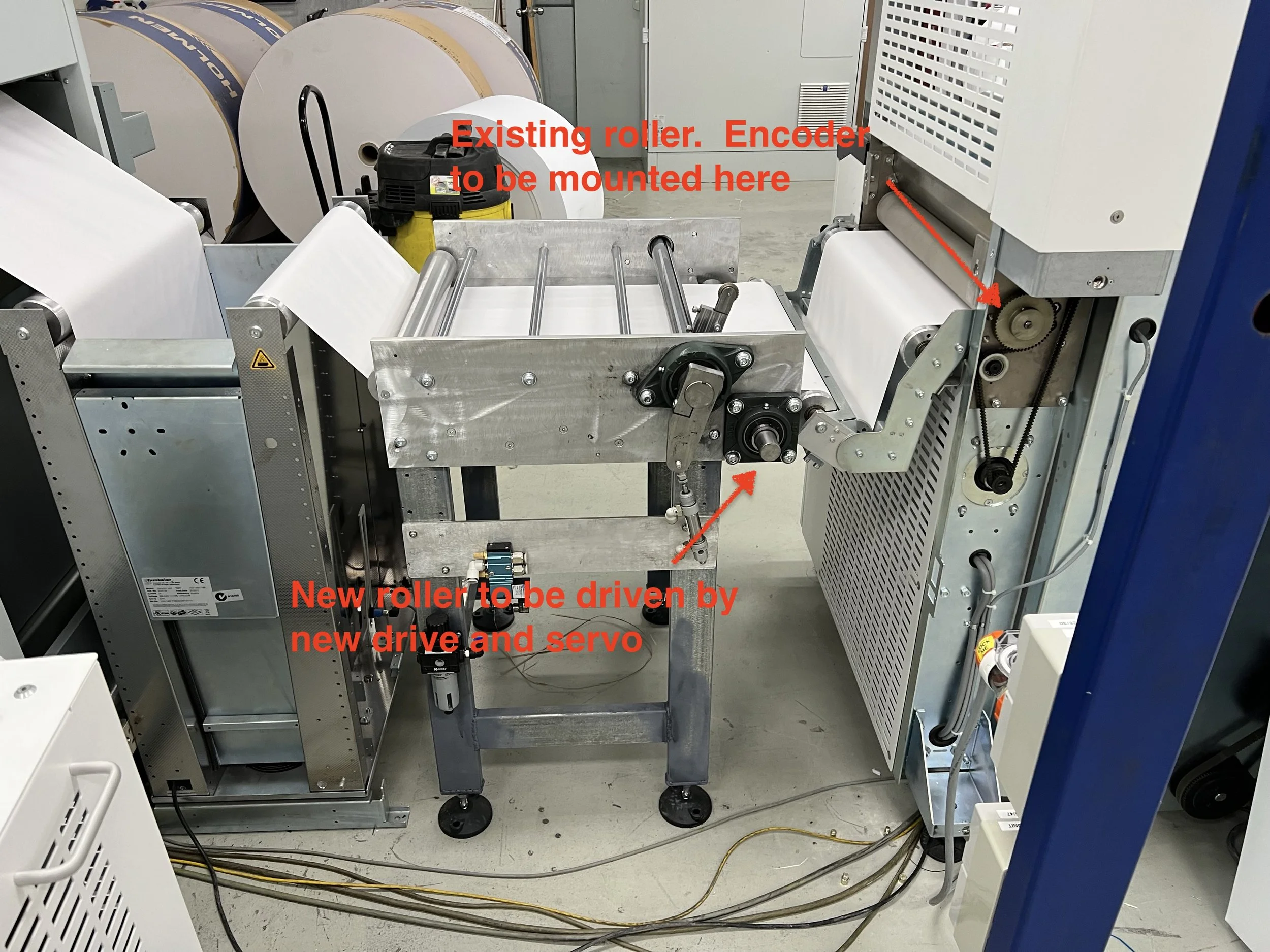
Perforator table on the printing line — the web runs through the roller section we controlled.
Early ideas included speed-referencing a driven roller from the press. When a clean speed reference from the printer proved hard to obtain — and a driven roller was no longer needed — we settled on a cleaner approach:
Two contrast sensors — one trigger for perforator up, one for perforator down
An incremental encoder for precise position feedback along the web
A compact PLC to time the actuation from those inputs
Hardware we used
We selected industrial parts suited to high-speed print finishing:
SICK KTS Prime contrast sensors — fast, reliable registration-mark detection for the up and down triggers
SICK DFS60 incremental encoder (type DFS60B-BHPM10000, 10,000 pulses/rev) — position feedback for accurate timing along the web
Mitsubishi MELSEC FX3G PLC (FX3G-14M) — high-speed counting and control logic
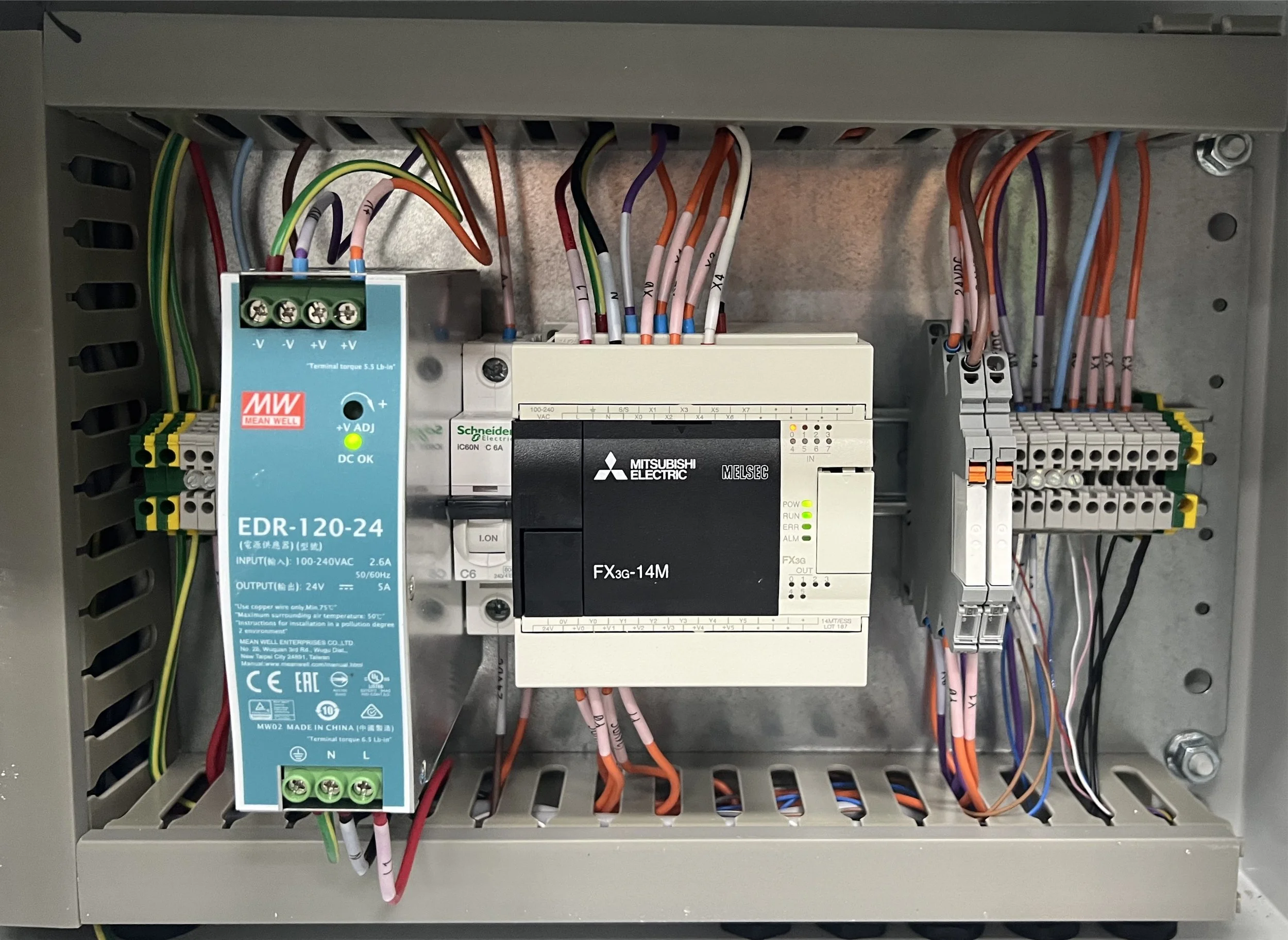
Workshop-built control cabinet — Mitsubishi FX3G PLC, Mean Well 24 V supply and labelled field wiring.
Design, build and install
Workshop build — control cabinet assembled and programmed as far as practical before going to site
Onsite install — cabinet mounted on the perforator table; sensors fitted; encoder cable run; remote Auto / Off / Manual switch installed
Commissioning — system powered up and exercised on real product
Commissioning results
We ran commissioning tests at 75, 100 and 127 m/min. The perforator control performed at each speed (with timing parameters tuned per speed). The customer asked for production to be locked in at 100 m/min — we set and tested at that speed, and the system met their requirements.
Later program refinements kept the table aligned with how they run the line day to day.
Why this matters
This job is typical of the control work we do around printing and converting equipment:
Choose sensors and feedback that match the real process (marks on a moving web)
Build and prove as much as possible in the workshop
Commission on site at production speed
Leave the customer with a system that is simple to run (Auto / Off / Manual) and tuned for how they actually produce
If you need registration, timing or machine control upgraded on a press, converting line or finishing table, we can design, build and commission a practical solution around proven industrial parts.